My 2010 bachelor thesis on firm size and innovation
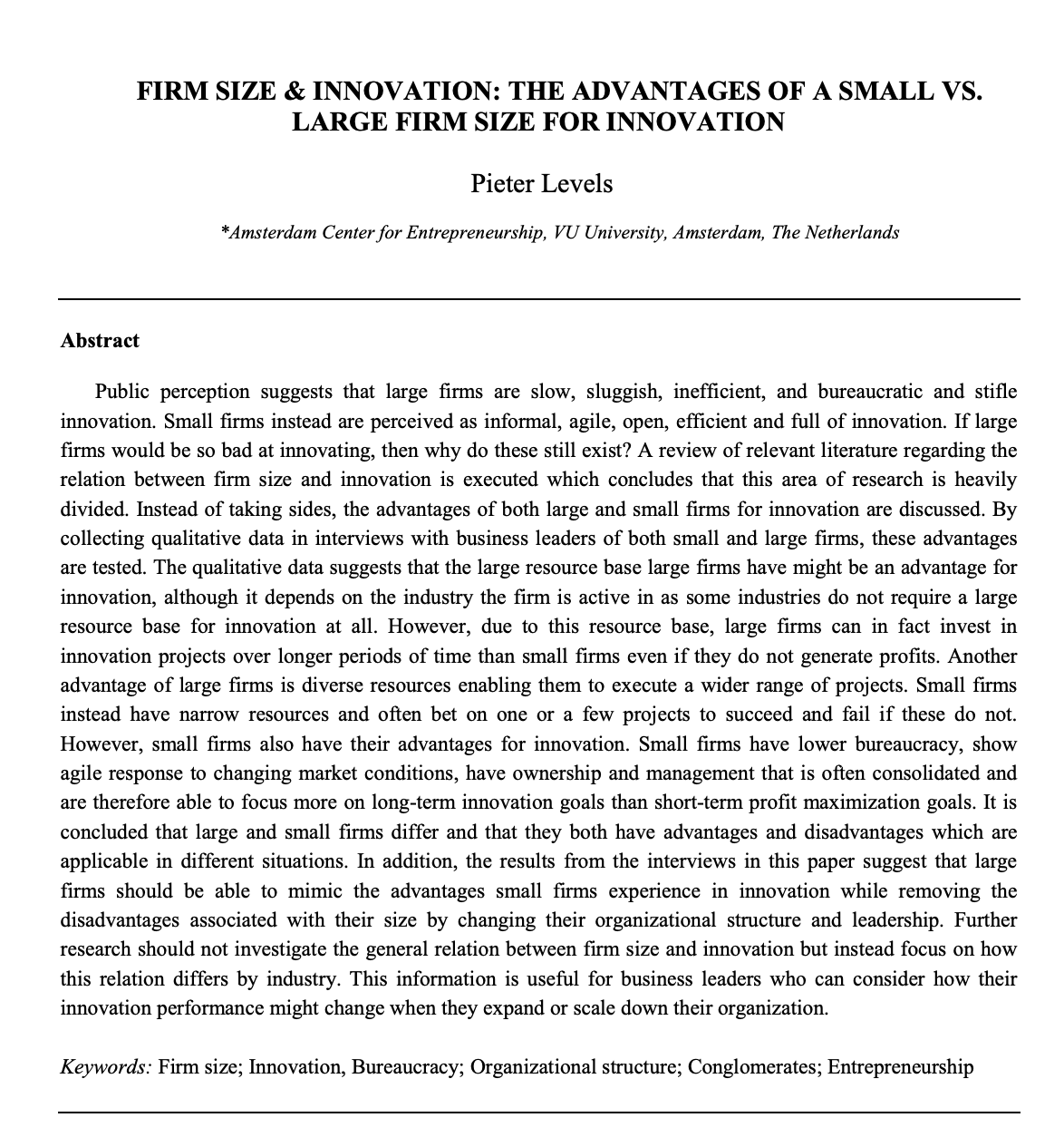
My bachelor thesis at the Amsterdam Center for Entrepreneurship, VU University Amsterdam, September 2010. I interviewed business leaders at both small and large firms to test whether small firms really do innovate better.
Abstract
Public perception suggests that large firms are slow, sluggish, inefficient, and bureaucratic and stifle innovation. Small firms instead are perceived as informal, agile, open, efficient and full of innovation. If large firms would be so bad at innovating, then why do these still exist? A review of relevant literature regarding the relation between firm size and innovation is executed which concludes that this area of research is heavily divided. Instead of taking sides, the advantages of both large and small firms for innovation are discussed. By collecting qualitative data in interviews with business leaders of both small and large firms, these advantages are tested.
The qualitative data suggests that the large resource base large firms have might be an advantage for innovation, although it depends on the industry the firm is active in as some industries do not require a large resource base for innovation at all. However, due to this resource base, large firms can in fact invest in innovation projects over longer periods of time than small firms even if they do not generate profits. Another advantage of large firms is diverse resources enabling them to execute a wider range of projects. Small firms instead have narrow resources and often bet on one or a few projects to succeed and fail if these do not.
However, small firms also have their advantages for innovation. Small firms have lower bureaucracy, show agile response to changing market conditions, have ownership and management that is often consolidated and are therefore able to focus more on long-term innovation goals than short-term profit maximization goals.
It is concluded that large and small firms differ and that they both have advantages and disadvantages which are applicable in different situations. In addition, the results from the interviews in this paper suggest that large firms should be able to mimic the advantages small firms experience in innovation while removing the disadvantages associated with their size by changing their organizational structure and leadership. Further research should not investigate the general relation between firm size and innovation but instead focus on how this relation differs by industry. This information is useful for business leaders who can consider how their innovation performance might change when they expand or scale down their organization.
Keywords: Firm size; Innovation; Bureaucracy; Organizational structure; Conglomerates; Entrepreneurship
Levels, P. (2010). Firm Size & Innovation: The Advantages of a Small vs. Large Firm Size for Innovation. Amsterdam Center for Entrepreneurship, VU University Amsterdam.
P.S. I'm on 𝕏 too if you'd like to follow more of my stories. And I wrote a book called MAKE about building startups without funding. See a list of my stories or contact me.
Never miss a post: 184,244 people read my posts in full by email, before it spreads anywhere else